

For homeschool families

Homeschool lessons your 5th grader passes by explaining them back.

They read a short lesson, then explain it in their own words to a guide that asks questions instead of giving answers. You see every idea they've explained.

One free lesson for each child. No card needed. Then $12 a month for one child, or $19 for up to 4.

21 courses · 120 lessons · About 20 minutes each

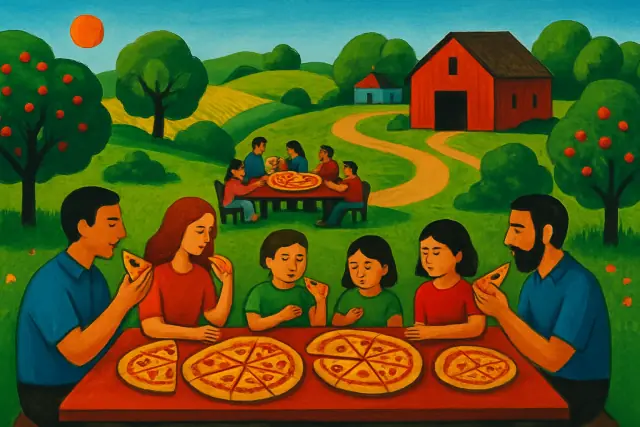
A short demo of one lesson. Maya reads “How much pizza does each friend get?”. Then the guide asks: “How can 4 friends share 3 pizzas equally?” She answers in her own words, the guide asks how to check the share, and she passes. Her parent’s Family page then shows the ideas she can explain: How to cut the pizzas and Checking a share.

A shortened example from Fractions as division.

Every lesson starts with a question.

Here are some of the 120 your 5th grader will be able to answer, and explain.

  • Is a half plus a third two fifths?
  • Does ice weigh more than water?
  • Who did "We the People" include?
  • Is the Sun a star?
  • Can multiplying make a number smaller?
  • Does a tree grow out of its soil?
  • How does a good story end?
  • Where does a square belong?
  • Who lived in the Americas before 1492?
  • Can you trust this source?
  • How do 3 friends share 5 brownies?
  • How did a river carve the Grand Canyon?
  • Why does length × width × height work?
  • Where does the energy in your food come from?
  • Is every opinion as good as another?
  • Why did the colonists grow angry?
  • Is air really stuff?
  • What does the remainder tell you?
  • How do similes and metaphors work?
  • Why does day turn to night?
  • Why do two people who were there tell it differently?
  • What began in Virginia in 1619?
  • What is each digit in a decimal worth?
  • Why does a comma follow an opener?

How it works

Read it. Explain it back. Then the next one opens.

No videos to sit through and no quiz to guess at. A short lesson, then a short conversation.

  1. Step 1

    Read a short lesson

    Five to ten minutes of plain writing, with pictures and diagrams. Each lesson answers one question.

  2. Step 2

    Explain it back

    A guide asks about the lesson's key ideas, and your child answers in their own words. It can give a hint. It doesn't hand over the answer.

  3. Step 3

    The next lesson opens

    Once they've got the ideas across. If it's not there yet, they reread and try again, with new questions.

The guide is an AI. It tells your child what came through as they go, and the result comes at the end.

What's inside

All four core subjects of 5th grade.

21 courses and 120 lessons, about 20 minutes each. One lesson a day, 4 days a week, covers the year in about 30 weeks.

  • Fractions as division

    Find out why 3 pizzas shared by 4 friends gives each 3/4 of a pizza, how to share what's left over after dividing, and how a story decides what a remainder means.

    5 lessonsLessons inside
    1. 1How much pizza does each friend get?
    2. 2Why is 3/4 the same as 3 ÷ 4?
    3. 3How do 3 friends share 5 brownies?
    4. 4How do you share what's left over?
    5. 5What does the leftover mean in the story?
  • Adding fractions with unlike denominators

    Find out why a half plus a third isn't two fifths, how to cut fractions into pieces of one size to add and subtract them, mixed numbers too, and how to tell if an answer makes sense.

    6 lessonsLessons inside
    1. 1Is a half plus a third two fifths?
    2. 2How do you make the pieces the same size?
    3. 3Which bottom number should you use?
    4. 4How do you subtract fractions with different bottom numbers?
    5. 5How do you add and subtract mixed numbers?
    6. 6How can you tell if an answer makes sense?
  • Multiplying and dividing fractions

    Find out what it means to take a fraction of a number or of a fraction, why multiplying can give a smaller answer, and how to divide with unit fractions.

    6 lessonsLessons inside
    1. 1What does 2/3 × 4 mean?
    2. 2What is a part of a part?
    3. 3What is the area of a 3/4 m by 2/3 m garden bed?
    4. 4Can multiplying make a number smaller?
    5. 5How do you multiply with mixed numbers?
    6. 6What do 1/3 ÷ 4 and 4 ÷ 1/5 mean?
  • Decimals to thousandths and decimal operations

    Find out what each digit of a decimal is worth, why digits move when you multiply by 10, and how to compare, round, add, subtract, multiply and divide decimals.

    6 lessonsLessons inside
    1. 1What is each digit in a decimal worth?
    2. 2What happens when you multiply or divide by 10, 100 or 1,000?
    3. 3How do you compare and round decimals?
    4. 4How do you add and subtract decimals?
    5. 5How do you multiply decimals?
    6. 6How do you divide decimals?
  • Multi-digit multiplication and division

    Find out why the usual way to multiply big numbers works, divide them in friendly chunks, check your answers, and decide what a remainder means in a story.

    5 lessonsLessons inside
    1. 1How can you multiply big numbers in parts?
    2. 2What does each row of the standard algorithm mean?
    3. 3How does multiplying help you divide?
    4. 4What if a chunk is too big or too small?
    5. 5What does the remainder tell you?
  • Volume, and writing expressions

    Fill boxes with cubes to measure volume, see why length × width × height works, add the volumes of two boxes, and use parentheses to write and read calculations.

    6 lessonsLessons inside
    1. 1What does volume measure?
    2. 2How do you count the cubes in a box?
    3. 3Why does length × width × height work?
    4. 4How do you find the volume of a solid made of two boxes?
    5. 5What do parentheses do in an expression?
    6. 6How can you compare expressions without working them out?
  • The coordinate plane, patterns and shape hierarchy

    Name any spot on a grid with two numbers, turn two number patterns into points, and sort four-sided shapes into families. Is a square a rectangle? You'll find out.

    6 lessonsLessons inside
    1. 1How do two numbers name one place?
    2. 2What can a point tell you?
    3. 3How are two patterns related?
    4. 4What do two patterns look like on a grid?
    5. 5What puts a shape in a family?
    6. 6Where does a square belong?

Also ready: Grade 6 Math, Grade 3 Reading and Writing, Algebra 1 and English 9. More grades are on the way.

What you see

See what they can explain, not just what they finished.

Your Family page shows each child's courses, how far they are, and the ideas they've explained, by name.

  • Read every lesson first

    Open any course and read it yourself, free, before your child does.

  • Learn alongside them

    Every plan includes you. Take the same courses if you'd like.

  • Certificates to keep

    One for every course, class and grade they finish.

An example of a child's page: the courses Maya is taking, how far she is in each, and the ideas she can explain.

Straight answers

How it's made, and what it isn't.

You should know both before you try it.

How every course is made

  1. 1

    Researched first

    Each course starts from what 5th graders are expected to learn, and from the mix-ups children commonly have.

  2. 2

    Drafted with AI, to a strict standard

    Plain words, short sentences, real examples, and one question for each lesson.

  3. 3

    Checked claim by claim

    Every checkable fact is listed and checked against its source, then reviewed by a second, independent AI model.

  4. 4

    Tried before your child tries it

    Simulated learners take every check, so a careful reader passes and a guesser doesn't.

  5. 5

    Open to you

    Lessons are fixed text, not written on the spot. Read any of them, free, before your child does.

What it isn't

  • Not an all-in-one

    It's the core ideas of 5th grade in about 20 minutes a day. You add books, math practice and the rest of your day.

  • No videos or games

    Short reading, then a conversation. That's all of it.

  • Not for every age yet

    5th grade is complete. Your child needs to be comfortable typing a few sentences.

  • Not a school

    No accreditation, transcripts or attendance records. You get progress and certificates.

  • Follows US grade-level standards

Why it works

Explaining is how understanding shows.

Research on learning keeps finding the same thing.

These are studies of the method, not of EverySchool.

Plans

Try a lesson free. Then one price for every course.

Each child gets one free lesson, with its explain-it-back check. No card needed.

  • Free

    Try it with your child

    $0

    • One section for each child, explain-it-back check included
    • Read every course yourself, any grade, any subject
    • No card needed
  • One child

    1 parent and 1 child

    $12/ month

    Or $99 a year, save 31%

    • Every course, every grade and subject
    • You can take the courses too
    • Progress and certificates
  • Best for 2 or more children

    Family

    Up to 2 parents and 4 children

    $19/ month

    Or $149 a year, save 35%

    • Everything in One child
    • A second parent who manages and learns
    • Each child learns at their own grade
See plans and start free

Pay monthly or yearly. Cancel any time.

In the app, a lesson is called a section.

Children's accounts

Their account stays in your hands.

A child's account is made by you, and it only learns.

  • No email for your child

    You make their account from yours. They never need an address of their own.

  • They sign in through you

    Hand them your device, or give them a one-time code for theirs.

  • A child's account only learns

    No posting, no messaging and no making courses.

  • Yours to remove

    Remove a child, and their account and everything they did is deleted.

Questions

Good questions parents ask.

Something else? hello@everycourse.ai

No. It's the core ideas of 5th grade in math, science, reading and writing, and social studies, in about 20 minutes a day. Most families add books, math practice and projects of their own.

5th grade is complete: 21 courses and 120 lessons. Grade 6 Math, Grade 3 Reading and Writing, Algebra 1 and English 9 are complete too, and more are being added.

Yes, the guide is an AI. It asks about each lesson's key ideas, and your child answers in their own words. It can give a hint, but it's built not to hand over the answer, since the point is for your child to explain it.

About 20 minutes: five to ten to read, and the rest to explain it back. Some chats are quick and some take longer.

Yes. They type their answers in a chat, usually a sentence or two at a time, and that builds typing and writing skills too. Some children speak their answers instead, using the speech-to-text built into most phones, tablets and computers. A younger child can sit with you.

Each child's courses, how many lessons they've passed, when they last learned, the ideas they've explained and their certificates.

The curriculum is not religious. It follows US grade-level standards. You can read every lesson yourself, free, before your child starts.

We do, with AI. Each course is researched first, drafted to a strict standard, checked claim by claim against its sources, reviewed by a second AI model and tried by simulated learners before it's published.

Each child gets one lesson free, with no card. After that it's $12 a month for one child, or $19 a month for up to 4 children and 2 parents. Paying yearly costs less: $99 a year for one child, or $149 for a family. You can cancel any time.

Try one lesson free tonight.

Twenty minutes. Then ask them to explain it.

Start free

One free lesson for each child. No card needed. Then $12 a month for one child, or $19 for up to 4.